I have a rule I share with almost every transformation team I work with:
Most technology problems are data problems in disguise.
The new CRM is "slow"? Usually the data model or data volume. The analytics "do not match"? Usually definitions and ownership. The AI pilot "is not accurate"? Usually the data it was given.
Data architecture is the discipline that tries to prevent these problems before they happen.
What Data Architecture Covers
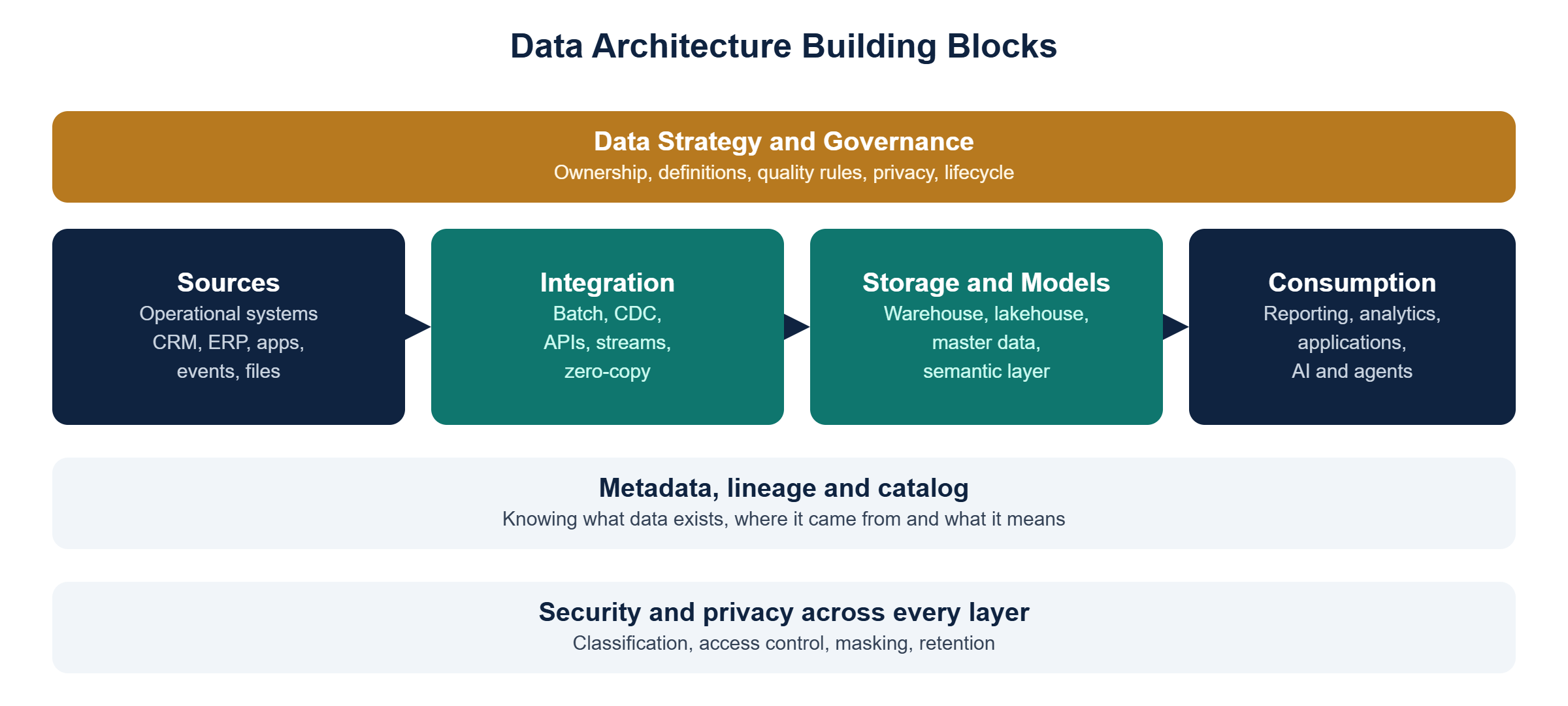
Data architecture defines how data is structured, stored, moved, governed and used across an organization. It includes:
- Data models: how key business concepts are represented
- Ownership: which system and which team owns each type of data
- Integration: how data moves between systems
- Storage: where data lives for operational and analytical use
- Governance: quality, privacy, security, retention and definitions
- Consumption: how people, applications and AI use data
The Foundations
Clear ownership
Every key data entity, such as Customer, Product or Order, needs a system of record and a business owner. Without ownership, every system keeps its own copy and quality slowly collapses.
Shared definitions
"Revenue", "active customer" and "churn" mean different things to different teams. A business glossary with agreed definitions removes a surprising amount of conflict.
Master data management
For the most important shared entities, organizations often need a way to match, merge and maintain a single trusted version across systems. This can be a dedicated MDM tool, a customer data platform, or a well-governed system of record.
Fit-for-purpose storage
Operational databases, data warehouses, data lakes and lakehouses each serve different needs. The goal is not one store for everything, but a clear purpose for each.
Metadata and lineage
Knowing what data exists, where it came from and how it was transformed is essential for trust, compliance and troubleshooting.
Common Mistakes
- Copying data everywhere: every copy creates a new place for errors and privacy risk
- Technology first: buying a data platform before agreeing on ownership and definitions
- Ignoring quality at the source: fixing data downstream forever instead of once at the source
- Treating governance as paperwork: governance only works when it is built into processes and tools
Data Architecture for AI
AI has turned data architecture from a back-office concern into a strategic one. Models and agents need data that is accurate, current, well described and appropriately protected. In practice, that means:
- Clear access controls on what AI can see
- Good metadata so AI can understand what data means
- Quality checks before data reaches models
- Lineage, so AI outputs can be traced back to sources
Organizations that invested in data architecture are finding AI adoption dramatically easier.
Final Thought
Data architecture is not about storing data.
It is about making data something the business can trust, so every decision, report and AI agent built on top of it stands on solid ground.