Building an API is the easy part.
Running hundreds of them safely, reliably and visibly, for dozens of consumers, is a completely different challenge. That is what API management is for.
When I talk to organizations that are struggling with APIs, the problem is rarely the APIs themselves. It is that nobody can see who is using what, security is applied inconsistently, and nobody knows which APIs already exist.
What API Management Does
API management is the set of tools and practices that sit between API consumers and the services behind them.
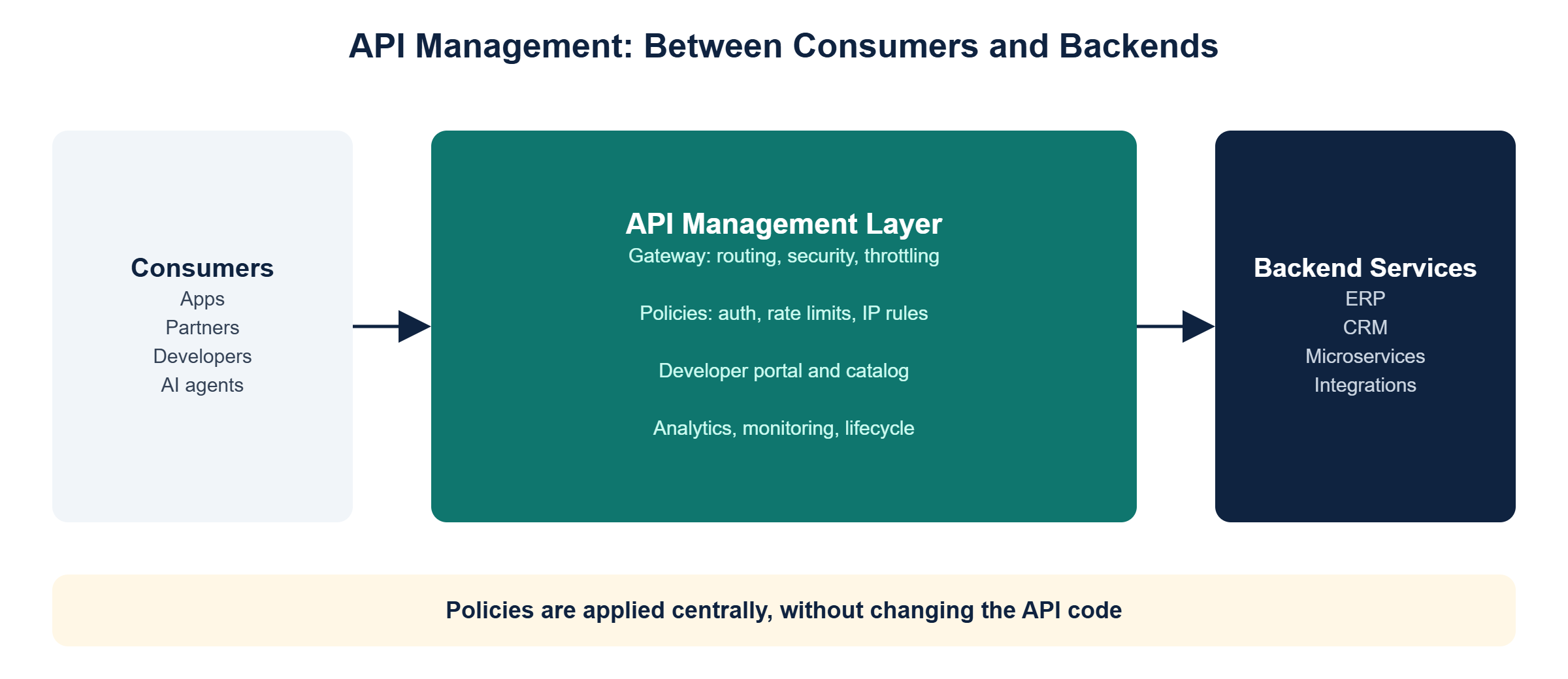
It typically includes:
- An API gateway that receives every request, applies rules and routes it to the right backend
- Policies for authentication, authorization, rate limiting, IP filtering and transformation
- A developer portal where consumers can discover, understand and request access to APIs
- Analytics and monitoring that show usage, performance and errors
- Lifecycle management for publishing, versioning and retiring APIs
Popular platforms include MuleSoft Anypoint API Manager, Apigee, Azure API Management, AWS API Gateway and Kong, among others.
Why It Matters
Consistent security
Instead of every team implementing security differently, policies are applied centrally at the gateway. One place to enforce OAuth, one place to block abuse, one place to audit.
Protection for backend systems
Rate limits and quotas stop one enthusiastic consumer from overwhelming a fragile system of record. I have seen this single capability prevent more than one outage.
Visibility
Which APIs are actually used? By whom? How fast are they? Which consumers will be affected if we change something? Without analytics, these questions are guesswork.
Reuse
A searchable catalog turns APIs into reusable assets. Without it, teams build duplicates simply because they did not know something already existed.
Separation of concerns
Developers focus on business logic. Cross-cutting concerns like security, throttling and logging are handled by policies, often without changing a single line of API code.
Running an API Program, Not Just a Gateway
Buying a gateway does not create an API program. The organizations that get real value usually also have:
- API ownership: every API has a named owner responsible for its quality and roadmap
- Design standards: consistent conventions across all APIs
- A clear onboarding process: consumers can get access quickly, without weeks of email
- Versioning and deprecation rules: consumers know how and when changes happen
- Usage reviews: regular checks on which APIs are valuable and which can be retired
Common Mistakes
- Treating API management as an infrastructure purchase rather than a capability
- Applying heavy approval processes that make consumers give up
- Publishing APIs in the portal without useful documentation or examples
- Never retiring old versions, so the landscape keeps growing
- Ignoring internal APIs and only managing external ones
API Management in the Age of AI
AI agents are becoming a major new type of API consumer. They need clear descriptions, tight permissions and careful monitoring, because they can call APIs far faster and more often than humans. API management platforms are evolving to handle agent traffic, and the policies you define today will be the guardrails your agents rely on tomorrow.
Final Thought
API management is not about controlling APIs.
It is about making them safe to share widely, so that the value of every API you build can be multiplied across the whole organization.