For a long time, enterprise security was built like a castle.
Strong walls around the network. Everyone inside was trusted. Everyone outside was not.
That model stopped working the day applications moved to the cloud, employees started working from anywhere, and partners needed access to internal systems. Today there is no single wall to defend.
What replaced it is a simple but powerful idea: identity is the new perimeter.
Why Identity Is at the Center
In a modern enterprise, almost every security question starts with identity:
- Who is this user, system or agent?
- How do we know it is really them?
- What are they allowed to do?
- What did they actually do?
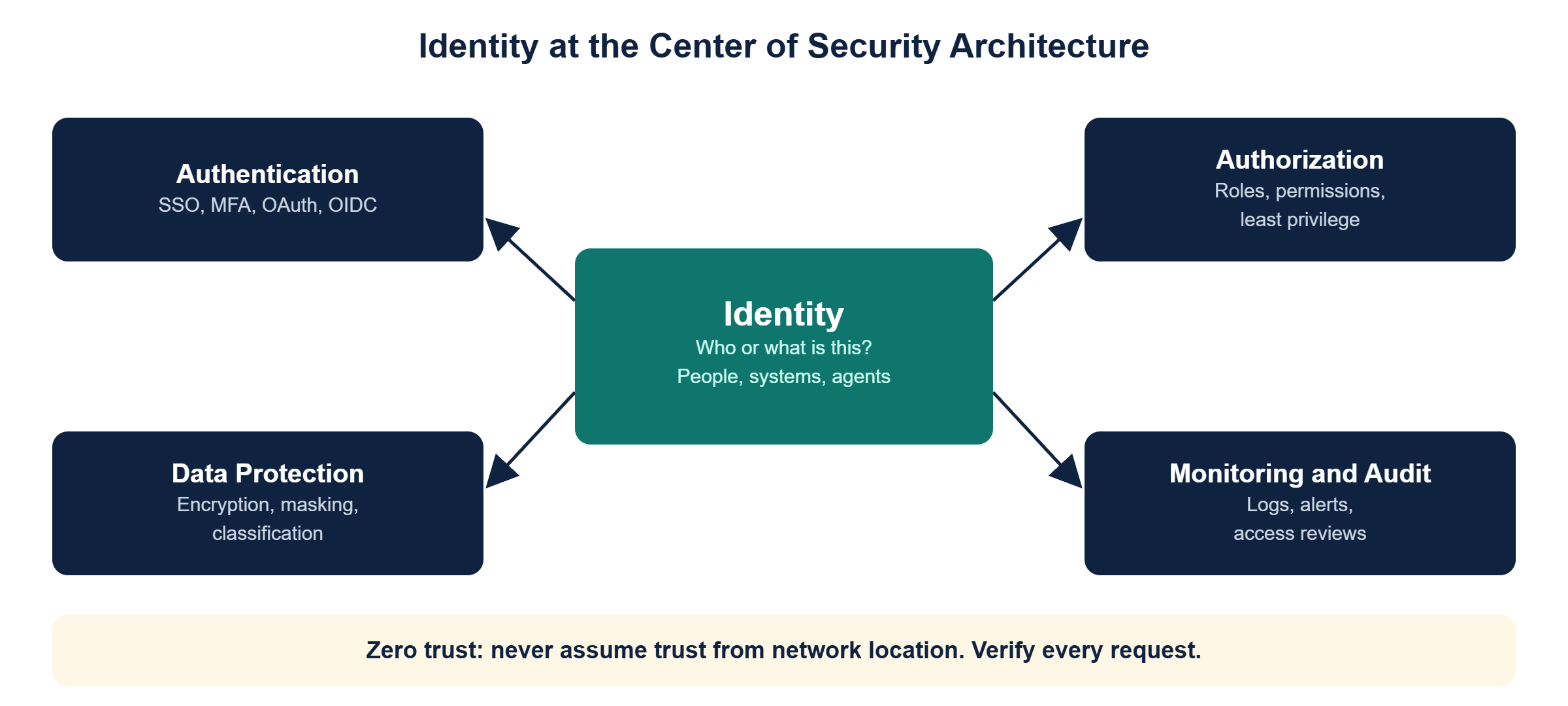
The Building Blocks
Authentication
Proving that someone is who they claim to be. Single sign-on (SSO) gives users one identity across applications. Multi-factor authentication (MFA) dramatically reduces account takeover risk. Standards such as SAML, OAuth 2.0 and OpenID Connect allow applications to trust a central identity provider.
Authorization
Deciding what an authenticated identity may do. Role-based access, attribute-based access and fine-grained permissions all play a part. The guiding principle is least privilege: give only the access needed, and nothing more.
Machine and system identities
Integrations, services and scripts need identities too. Each one should have its own credentials, with minimal permissions, managed secrets and regular rotation. Shared "integration admin" accounts are one of the most common risks I see in enterprise landscapes.
Data protection
Encrypt data in transit and at rest, classify sensitive data, and mask or tokenize it where full values are not needed.
Monitoring and audit
Log access and important actions, alert on unusual behavior, and regularly review who has access to what. Access tends to grow over time unless someone actively removes it.
Zero Trust in Plain Language
Zero trust is often described in complicated ways. The core idea is simple:
Never trust a request just because of where it comes from. Verify every request, every time.
That means strong authentication, least-privilege authorization, device and context checks, and continuous monitoring, whether the request comes from the office network or a coffee shop.
Identity for AI Agents
AI agents are a new kind of identity, and many organizations are not ready for them. An agent that can read data and take actions needs:
- Its own identity, separate from the human it works for
- Clearly limited permissions
- Rules for when it must ask a human for approval
- Full logging of what it accessed and did
Designing agent identity carefully now will avoid very painful incidents later.
Common Mistakes
- Treating security as a final review instead of a design input
- Over-privileged service accounts with passwords that never change
- No regular access reviews, so former roles keep their permissions
- Securing applications but forgetting the integrations between them
Final Thought
Security architecture is no longer about building higher walls.
It is about knowing exactly who and what is acting in your environment, and making sure each one can do only what it should.