A few years ago, AI governance meant reviewing a handful of data science models a year.
Today, almost every department is experimenting with AI. Someone in marketing is using a generative AI tool for campaigns. Someone in finance is summarizing contracts. A product team is building an agent that can update customer records on its own.
Most of this is happening faster than any policy can keep up with.
That is exactly why AI governance has moved from a niche compliance topic to a core architecture concern.
AI governance is not about slowing AI down. It is about making it safe enough to scale.
What AI Governance Covers
AI governance is the set of principles, processes, roles and technical controls that ensure AI is used responsibly, securely and in line with business goals and regulations.
In practice, it answers questions like:
- Which AI use cases are we comfortable with, and which need extra scrutiny?
- What data can AI systems use, and what must they never see?
- Who is accountable when an AI system makes a wrong decision?
- What can an AI agent do on its own, and when must a human approve?
- How do we know a model is still behaving the way we expect?
Why It Is Different From Traditional IT Governance
Traditional systems do what they were programmed to do. AI systems are probabilistic. The same input can produce different outputs, quality can drift over time, and behavior can be surprising in situations nobody tested.
Agents raise the stakes further. When an AI system can call APIs, update records or send messages, the question is no longer only "is the answer correct?" It becomes "should this action have happened at all?"
A Layered Approach
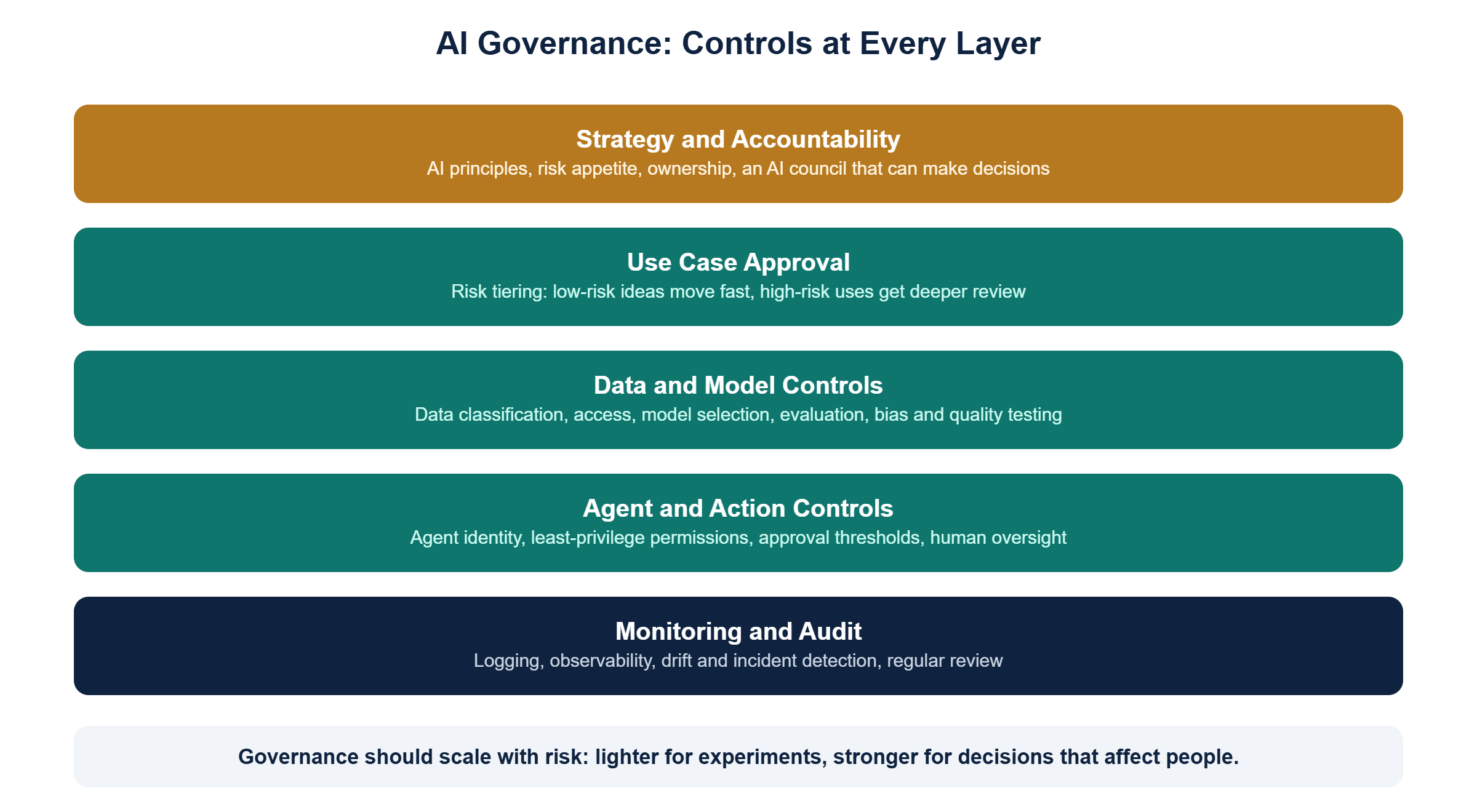
The most practical way I have found to think about AI governance is as a set of layers, each with its own controls.
Strategy and accountability
Start with a small set of AI principles and a clear owner. Many organizations create an AI council, but it only works if it can actually make decisions, not just discuss them. Every AI system in production should have a named business owner.
Use case approval
Not every AI use case carries the same risk. Summarizing internal meeting notes is very different from making credit decisions. Tier use cases by risk, and let low-risk ideas move quickly while high-risk uses get deeper review. Regulations such as the EU AI Act take a similar risk-based approach.
Data and model controls
AI is only as trustworthy as its data. Classify data, control what each AI system can access, and evaluate models for quality, bias and safety before they go live, not after a customer complaint.
Agent and action controls
This is the layer most organizations are still figuring out. Agents should have their own identity, the minimum permissions they need, and clear limits on what they can do without human approval. A useful rule: the more irreversible or customer-affecting an action is, the more likely it needs a human in the loop.
Monitoring and audit
Log prompts, outputs, tool calls and decisions in a way that can be reviewed later. Monitor for drift, errors and unusual behavior. When something goes wrong, and eventually something will, you need to be able to explain what happened.
The Role of the Architect
AI governance is often treated as a legal or risk exercise. Those teams are essential, but many of the most important controls are architectural:
- Designing how agents authenticate and what they are authorized to call
- Exposing capabilities through governed APIs instead of direct database access
- Building a context layer that controls what data reaches a model
- Making observability and audit trails part of the platform, not an afterthought
- Defining reference architectures so teams do not reinvent controls for every use case
Policies define what should happen. Architecture determines what can happen.
Frameworks Worth Knowing
You do not need to start from scratch. The NIST AI Risk Management Framework and the ISO/IEC 42001 standard for AI management systems both provide useful structure. As with any framework, adapt them to your organization rather than implementing them word for word.
Common Mistakes
Banning AI outright
Blanket bans rarely work. People use AI tools anyway, just without any oversight. It is better to provide approved tools with sensible guardrails.
Governing on paper only
A policy that says "agents must not access sensitive data" means little if the architecture allows it. Enforce rules technically wherever you can.
Treating every use case the same
Heavy review for low-risk experiments kills innovation. Light review for high-risk uses creates real danger. Risk tiering solves both problems.
Forgetting about life after launch
Models drift, data changes and business processes evolve. Governance has to continue after go-live.
Where to Start
If your organization is early in this journey:
- Create an inventory of the AI use cases already in progress. You will probably be surprised.
- Agree on a short set of AI principles and a simple risk-tiering model.
- Provide approved AI tools and platforms so teams are not tempted to go around you.
- Define reference controls for agents: identity, permissions, approvals and logging.
- Review high-risk use cases regularly, and learn from every incident.
Final Thought
The organizations that win with AI will not be the ones that adopt it fastest.
They will be the ones that can adopt it fast and still trust it. Good governance is what makes that possible.