For the first wave of generative AI, the pattern was simple: a person asks a question, the AI answers.
AI agents change that. An agent does not just answer. It pursues a goal: it decides what to do next, uses tools, checks the results and continues until the job is done or it needs help.
That is a big shift, and it brings both real opportunity and real architectural responsibility.
What an AI Agent Is
An AI agent is a system that uses a language model to reason about a goal, decide on actions, use tools such as APIs or search, observe the results, and repeat.
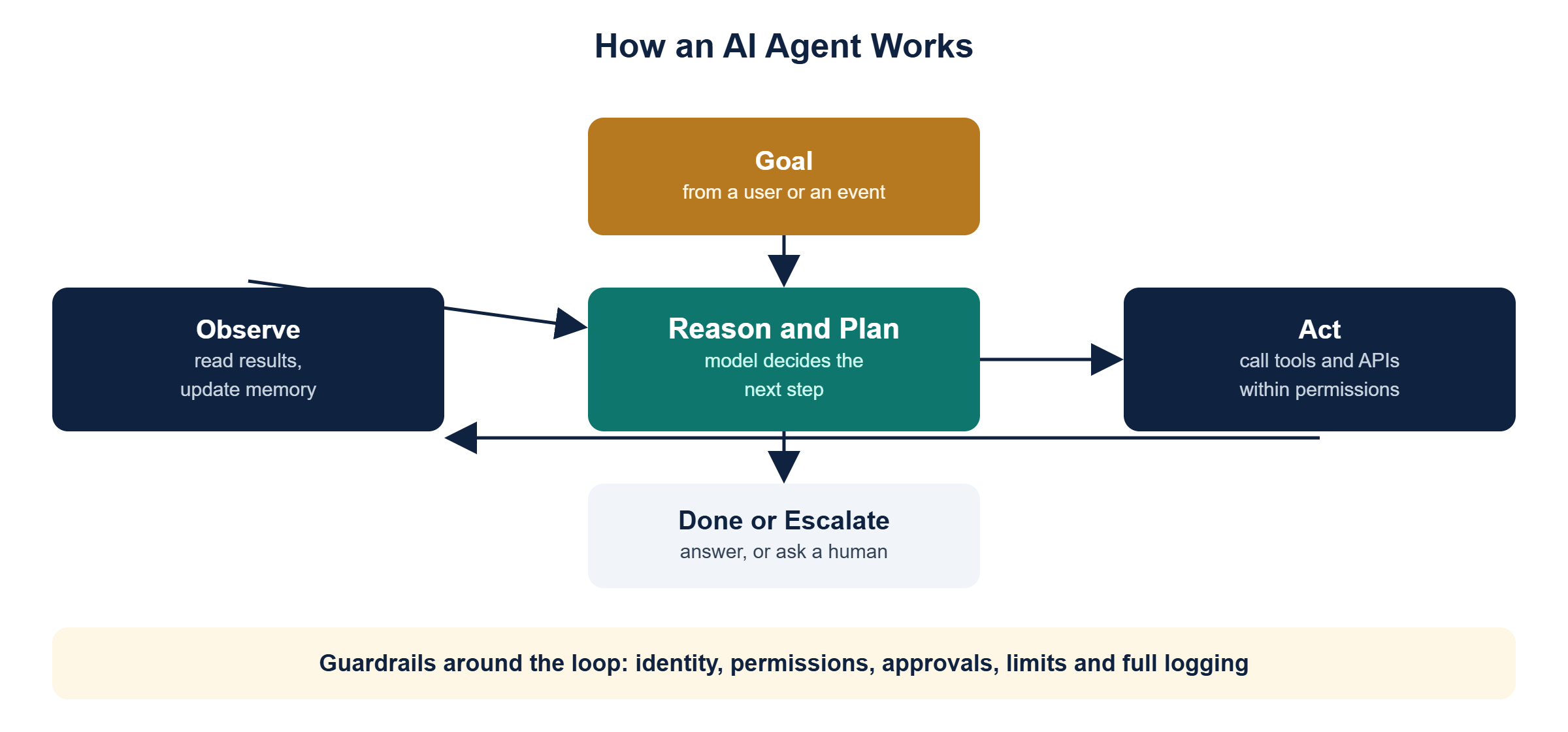
The key difference from a chatbot is autonomy. A chatbot responds. An agent acts.
Where Agents Add Real Value
In my view, the best early use cases share a few traits: repetitive, multi-step, rules-guided work across several systems. For example:
- Triaging and resolving common service requests
- Preparing quotes or proposals from CRM and pricing data
- Researching and summarizing account information before a sales meeting
- Reconciling data between systems and flagging exceptions
- Handling routine IT or HR requests end to end
Platforms like Salesforce Agentforce, Microsoft Copilot Studio and others are making these patterns more accessible inside existing applications.
The Risks Are Different
Agents introduce risks that traditional applications did not:
- Wrong actions, not just wrong answers
- Over-broad access, if an agent inherits too many permissions
- Prompt injection, where malicious content tricks an agent into doing something unintended
- Runaway loops and costs, if limits are not set
- Accountability gaps, when nobody is sure who owns an agent's decisions
Architecture Principles for Agents
Give each agent its own identity
Agents should not borrow a human's credentials. Give them a distinct identity with clearly scoped permissions.
Least privilege, always
Start with read-only access. Add write actions one at a time, with clear limits.
Expose capabilities through governed APIs
Agents should act through the same well-designed, secured APIs as any other consumer, never through direct database access.
Humans in the loop for consequential actions
Refunds above a threshold, contract changes, anything customer-facing or irreversible: require approval until trust is earned.
Log everything
Every reasoning step, tool call and outcome should be traceable for audit and improvement.
Evaluate before and after launch
Test agents against realistic scenarios, including adversarial ones, and keep monitoring quality in production.
Start Small
The organizations getting value from agents usually start with one narrow, well-understood process, prove the outcome, then expand. Ambitious "do everything" agents tend to stay in the demo stage.
Final Thought
AI agents will not replace enterprise architecture.
They will test it: every weakness in your data, APIs, security and governance will be exposed faster than ever. The organizations with strong foundations will be the ones that benefit first.