For decades, business applications have worked the same way.
They wait. A person opens a screen, types something in, clicks a button, and the application does exactly what it was programmed to do.
Intelligent applications work differently. They notice things. They suggest the next step. Sometimes they take it. And they get better as they learn.
What Makes an Application Intelligent
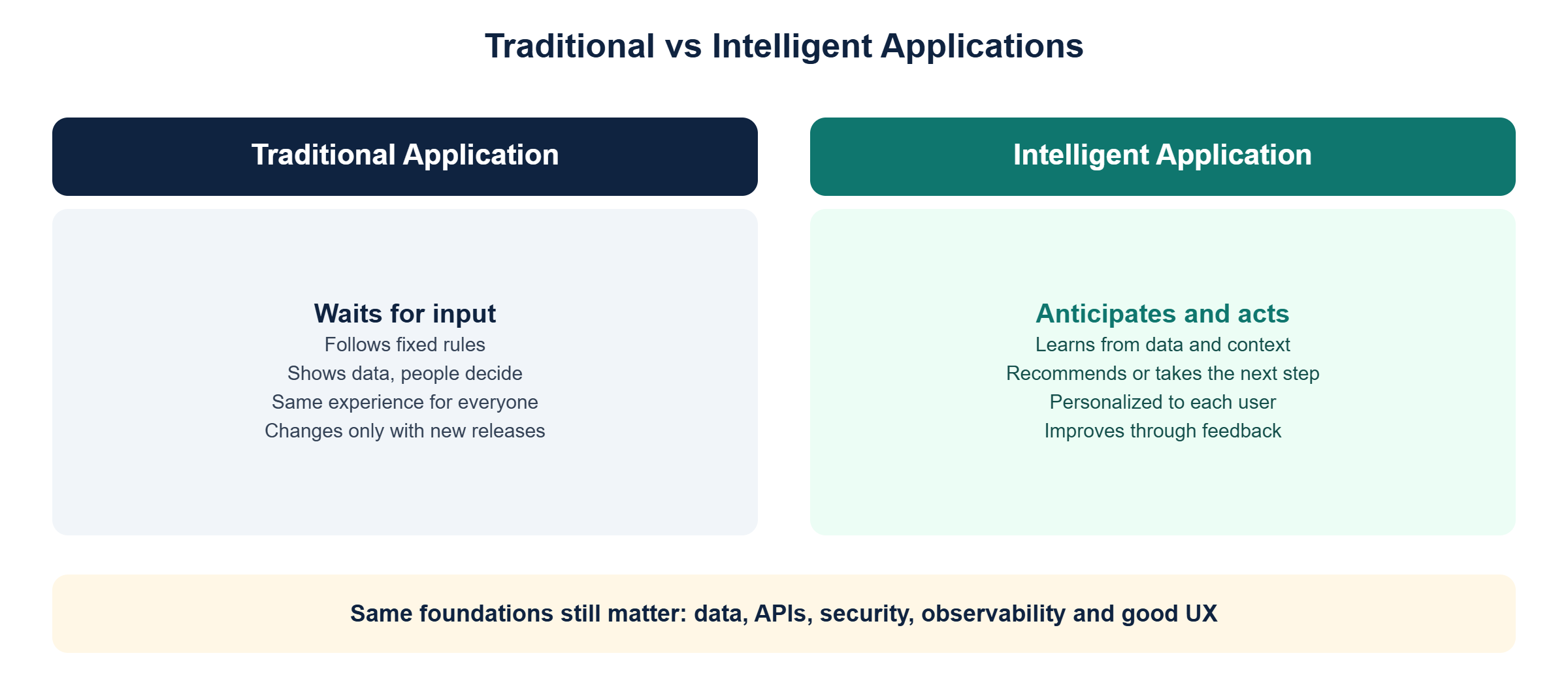
An intelligent application uses data, AI and context to:
- Anticipate what the user needs
- Recommend the next best action
- Automate routine decisions and steps
- Personalize the experience for each user
- Learn from outcomes and feedback
The intelligence is not a separate chatbot on the side. It is woven into the workflow itself.
Common Patterns
Recommendations
Suggesting the next product to offer, the best knowledge article for a case, or the most relevant document. Often the simplest and most valuable starting point.
Predictions
Scoring which leads are likely to convert, which customers might churn, or which invoices might be paid late, so people can focus their attention.
Summarization
Condensing long case histories, email threads or meeting notes into something a person can read in seconds.
Intelligent automation
Classifying and routing requests, extracting data from documents, and handling routine steps without human effort.
Embedded agents
Agents inside the application that can complete multi-step tasks on the user's behalf, within clear limits.
The Architecture Behind Them
Intelligent applications still rely on solid foundations:
- Data: accurate, timely and well-governed data is the fuel
- Events: real-time signals so the application can react as things happen
- APIs: so intelligence can read and act across systems
- Models and context: AI capabilities plus the enterprise knowledge they need
- Feedback loops: capturing whether suggestions were accepted and outcomes achieved
- Observability and governance: knowing what the application decided and why
Design Principles
Keep humans in control
Show why a recommendation was made. Make it easy to accept, change or reject. Trust grows when people understand the suggestion.
Start with one decision
Pick a single decision people make often, where better information would clearly help. Make that decision smarter before moving on.
Fail gracefully
When the AI is unsure or unavailable, the application should still work in a traditional way.
Measure outcomes
Track whether intelligence actually improves results: faster resolution, higher conversion, fewer errors.
Final Thought
The best intelligent applications do not feel like AI at all.
They simply feel like software that understands the work, and quietly makes it easier.