I have been on both sides of architect interviews many times.
As a candidate, I remember the nerves. As an interviewer, I have seen brilliant engineers struggle, not because they lacked knowledge, but because they prepared for the wrong kind of interview.
An architect interview is not a harder developer interview. It tests different things.
What Interviewers Are Really Looking For
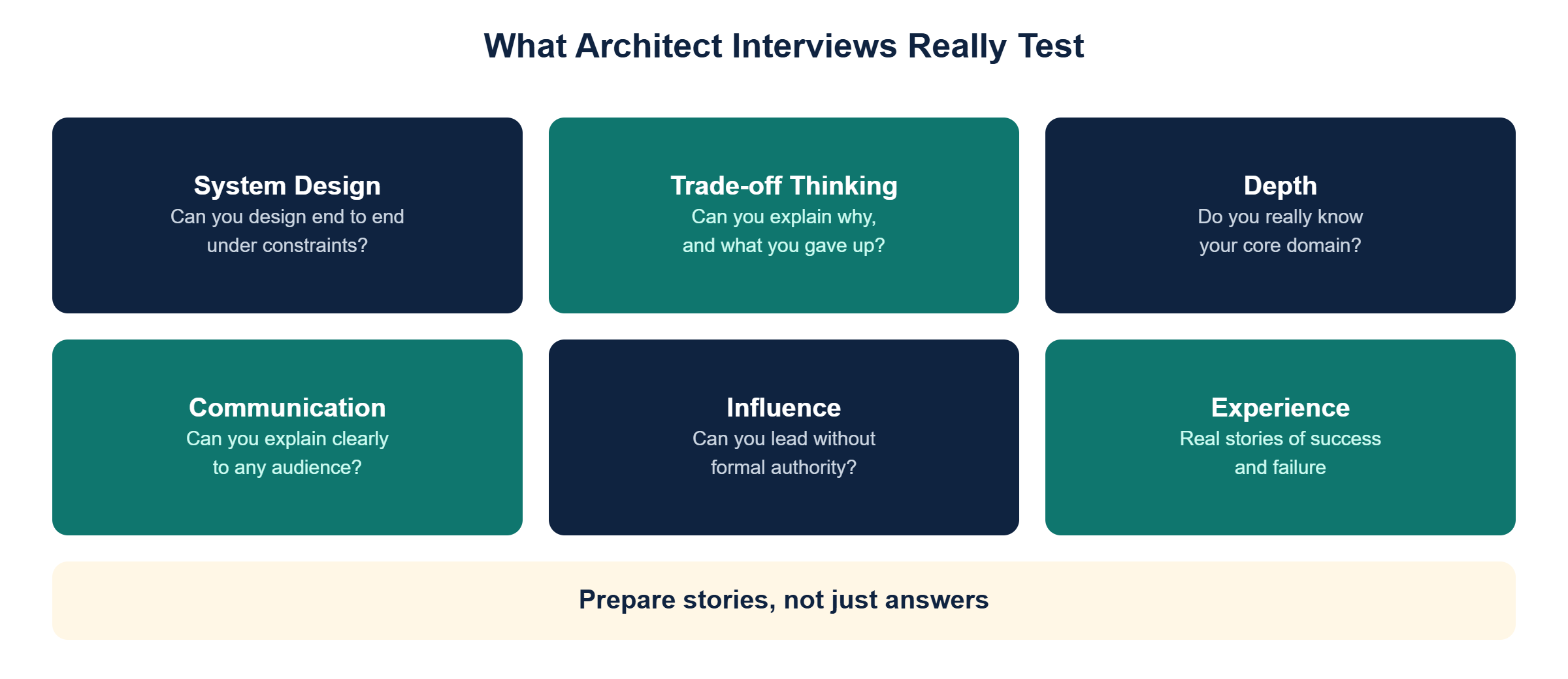
System design
Can you take a vague business problem and shape it into a sensible, end-to-end design? Interviewers care more about how you approach the problem than about the final diagram.
Trade-off thinking
This is the big one. Every design choice has a cost. Strong candidates say things like "I would choose X because of Y, accepting that we lose Z". Weak candidates present choices as if they had no downside.
Depth in your domain
Breadth matters for architects, but you also need real depth somewhere: integration, Salesforce, cloud, data or something else. Expect follow-up questions that go several levels deep.
Communication
Can you explain a design to an executive in two minutes, and to an engineer in twenty? Interviewers often test both.
Influence
Architects rarely have direct authority. Expect questions about convincing stakeholders, handling disagreement and leading without a title.
Real experience
Interviewers want stories: what you did, what went wrong, what you learned.
How to Prepare
Practice design problems out loud
Pick realistic scenarios: integrating a new SaaS platform, designing a customer 360 view, building an order management integration, adding an AI assistant to a service process. Talk through them out loud, ideally with someone else. Start with questions, not with boxes.
Use a consistent structure
When given a design problem, I suggest a simple flow:
- Clarify the business goal and scope
- Ask about users, volumes and constraints
- Identify non-functional requirements
- Sketch the high-level design
- Walk through key flows
- Discuss trade-offs, risks and alternatives
- Explain how it would evolve
Prepare five or six stories
Have real examples ready for: a difficult decision, a design that failed, a disagreement with a stakeholder, a time you simplified something complex, a time you mentored someone, and a time you changed your mind.
Refresh the fundamentals
Integration patterns, API design, security and identity, data architecture, cloud concepts and non-functional requirements come up in almost every architect interview.
Know the latest in your area
If you are interviewing for a Salesforce or integration architect role, be ready to discuss recent platform direction, especially around AI and agents.
Common Mistakes
- Jumping into technology before understanding the problem
- Never mentioning trade-offs
- Too much detail in one area, nothing about the rest
- Talking only about "we" without explaining your own role
- Pretending to know something instead of reasoning through it
That last one matters. Saying "I have not used that, but here is how I would think about it" is a strength in an architect, not a weakness.
Final Thought
The best architect candidates do not have all the answers.
They ask good questions, think in trade-offs, and explain their reasoning clearly. That is exactly what the job requires every day.