I once sat in an architecture review board meeting where a team presented a solution they had already built.
It was in production. Customers were using it. The review was a formality, and everyone in the room knew it. We asked a few questions, raised a few concerns, approved it with "recommendations", and moved on.
Nothing changed. Except that the team now saw architecture as a box to tick.
That meeting taught me more about governance than any framework ever did.
Architecture governance that arrives after the decision is not governance. It is archaeology.
What Architecture Governance Is For
Governance gets a bad name because it is often confused with control. But its purpose is actually quite positive:
- Making sure important decisions support the business strategy
- Avoiding duplicated investments and unnecessary complexity
- Managing risk around security, data and resilience
- Keeping the landscape coherent as dozens of teams make changes
- Sharing good decisions so others can reuse them
Done well, governance makes teams faster, because they are not solving the same problems from scratch or discovering problems late.
Why Traditional Governance Fails
Most organizations start with a review board. Teams submit documents, a committee meets, and designs are approved or rejected.
This model struggles for predictable reasons:
- It is too late. By the time a design reaches the board, the team is emotionally and financially committed.
- It is too slow. Waiting weeks for a meeting slot pushes teams to avoid the process.
- It reviews everything equally. A small UI change and a new core platform go through the same process.
- It focuses on compliance, not help. Teams leave with conditions, not better ideas.
The result is predictable. Teams learn to work around architecture, and architects lose influence exactly where they are needed most.
A Lighter, Better Model
The governance models I have seen work best share a few characteristics.
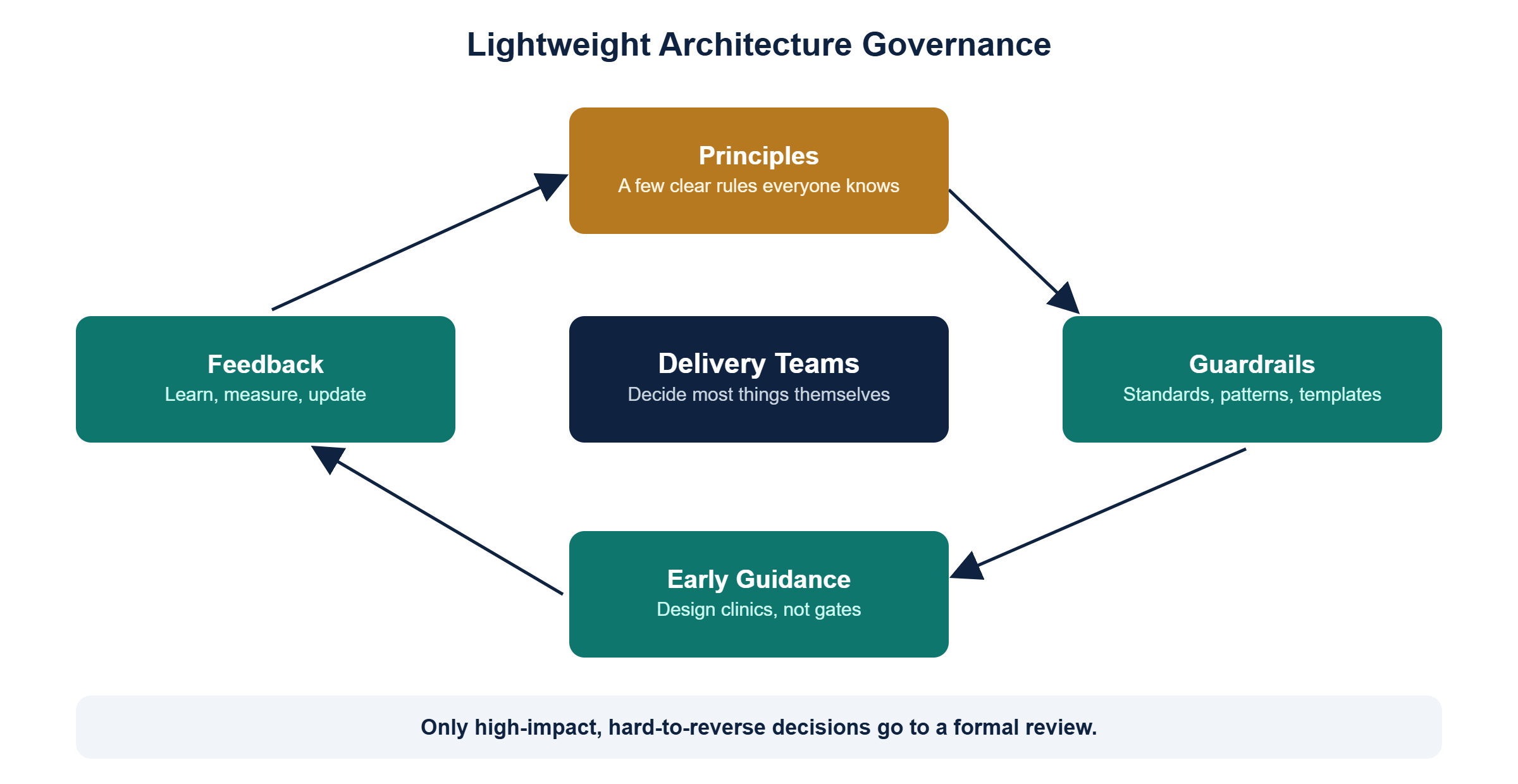
Start with a few clear principles
Not fifty. Five to ten principles that people can remember, such as "reuse before buy, buy before build", "APIs are products", or "customer data has one source of truth". Principles let teams make good decisions without asking permission.
Turn standards into guardrails
Reference architectures, approved patterns, templates and paved paths make the right thing the easy thing. A team that can start from an approved integration template will rarely invent a risky alternative.
Give guidance early
Replace late approval with early conversation. Weekly design clinics, office hours or an architect embedded in key programs catch issues when they are still cheap to fix.
Review by risk, not by default
Most decisions should be made by delivery teams. Only decisions that are high impact and hard to reverse, like a new platform, a new core data store or a major vendor commitment, need a formal review.
Record decisions
Architecture Decision Records capture what was decided and why. They create transparency, make reviews faster, and become a learning library for the whole organization.
Close the loop
Measure what happens after decisions are made. Did the pattern work in production? Did the platform deliver the expected value? Update the principles and guardrails based on what you learn.
What to Measure
If you want governance to earn respect, measure outcomes, not activity:
- Reuse of existing capabilities and APIs
- Reduction in duplicate applications and platforms
- Time from design to approval for significant decisions
- Number of production incidents linked to design issues
- How often teams come to architects voluntarily
That last one tells you more than any dashboard. When teams seek architects out, governance is working.
Governance for AI and Agents
AI brings new governance questions that most organizations have not yet answered. Which agents can access which data? Which actions can they take without a human? How are their decisions logged and audited? Who owns an agent once it is live?
The principles of good governance still apply: clear rules, sensible guardrails, early guidance and risk-based review. The stakes are simply higher, because agents act at machine speed.
A Simple Starting Point
If your current governance feels heavy, try this for one quarter:
- Publish no more than ten architecture principles.
- Introduce a weekly, informal design clinic open to any team.
- Define clearly which decisions require a formal review, and let teams own the rest.
- Start recording key decisions in a lightweight format.
- Ask teams, at the end of the quarter, whether architecture helped them.
Final Thought
The goal of governance is not to stop teams from making mistakes.
It is to help them make better decisions earlier, and to make sure the organization learns from every one of them.