Almost every large organization I speak with has AI pilots.
Many have dozens. Some have hundreds.
Far fewer can point to AI that has measurably changed how the business runs. The gap between an impressive demo and real enterprise value turns out to be wide, and crossing it has much more to do with architecture, data and people than with models.
Why AI Gets Stuck in Pilot Mode
The pattern is familiar:
- Every team experiments with its own tools
- Pilots use clean sample data instead of real, messy data
- Security and legal reviews arrive late and block deployment
- Nobody owns the outcome after the pilot ends
- Success is measured by excitement, not by business results
None of this is a model problem.
A Path From Pilots to Value
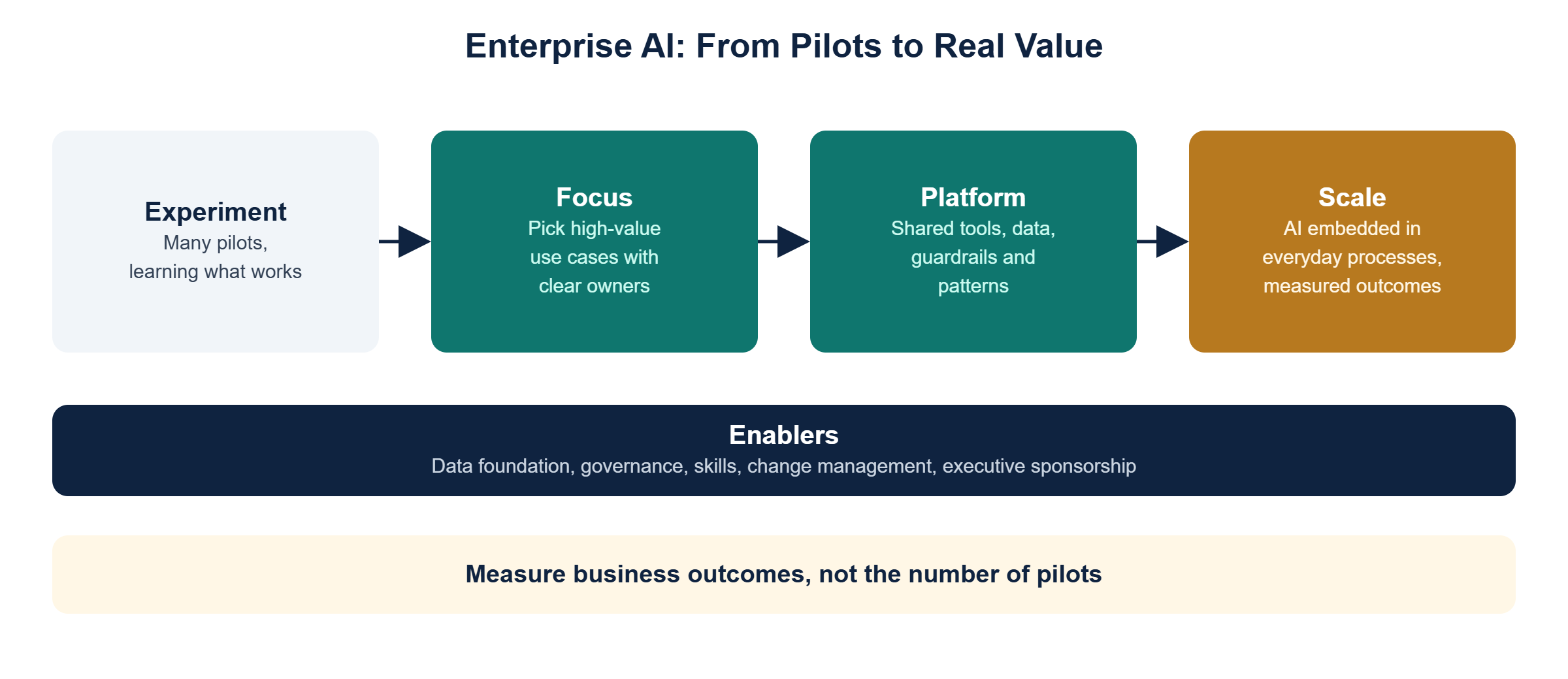
Experiment
Experimentation is healthy. It builds skills and reveals opportunities. The goal at this stage is learning, not production.
Focus
Choose a small number of use cases with clear business value, real data available, a committed business owner and measurable outcomes. Saying no to many ideas is what makes a few succeed.
Platform
Instead of every team building its own stack, provide shared capabilities: approved models, retrieval and data access, integration patterns, security controls, evaluation tools and cost tracking. This is where enterprise architects add enormous value.
Scale
Embed AI into the everyday processes and applications people already use, measure the results, and improve continuously.
The Enablers
Data foundation
AI is only as good as the data it can access. Investments in data quality, ownership and integration pay off quickly.
Governance
Clear rules on acceptable use, risk tiers and approvals let teams move faster with confidence.
Skills
People need to understand what AI can and cannot do, and how to work alongside it.
Change management
The hardest part is often not building AI, but changing how people work. Involve users early and redesign processes, not just tools.
Sponsorship
AI programs that report into a committed business leader tend to scale. Programs that live only in IT tend to stall.
Measuring What Matters
Track business outcomes such as time saved, cost reduced, revenue gained, customer satisfaction and error rates. Track adoption: are people actually using it? And track cost per use case, because usage-based pricing can grow quietly.
Final Thought
Enterprise AI is not a technology project. It is a business transformation that happens to use a powerful new technology.
The organizations that win will not be the ones with the most pilots. They will be the ones that turn a few good ideas into the way they work every day.