Quote to cash is one of those processes everybody depends on and almost nobody loves.
Sales configures a deal in one tool. Someone re-keys it into a contract system. Operations re-enters it for fulfilment. Finance rebuilds it again for billing and revenue recognition. Every handoff is a chance for numbers to drift, and every month someone spends days reconciling spreadsheets.
Salesforce Revenue Cloud is Salesforce's answer to that problem.
What Revenue Cloud Is
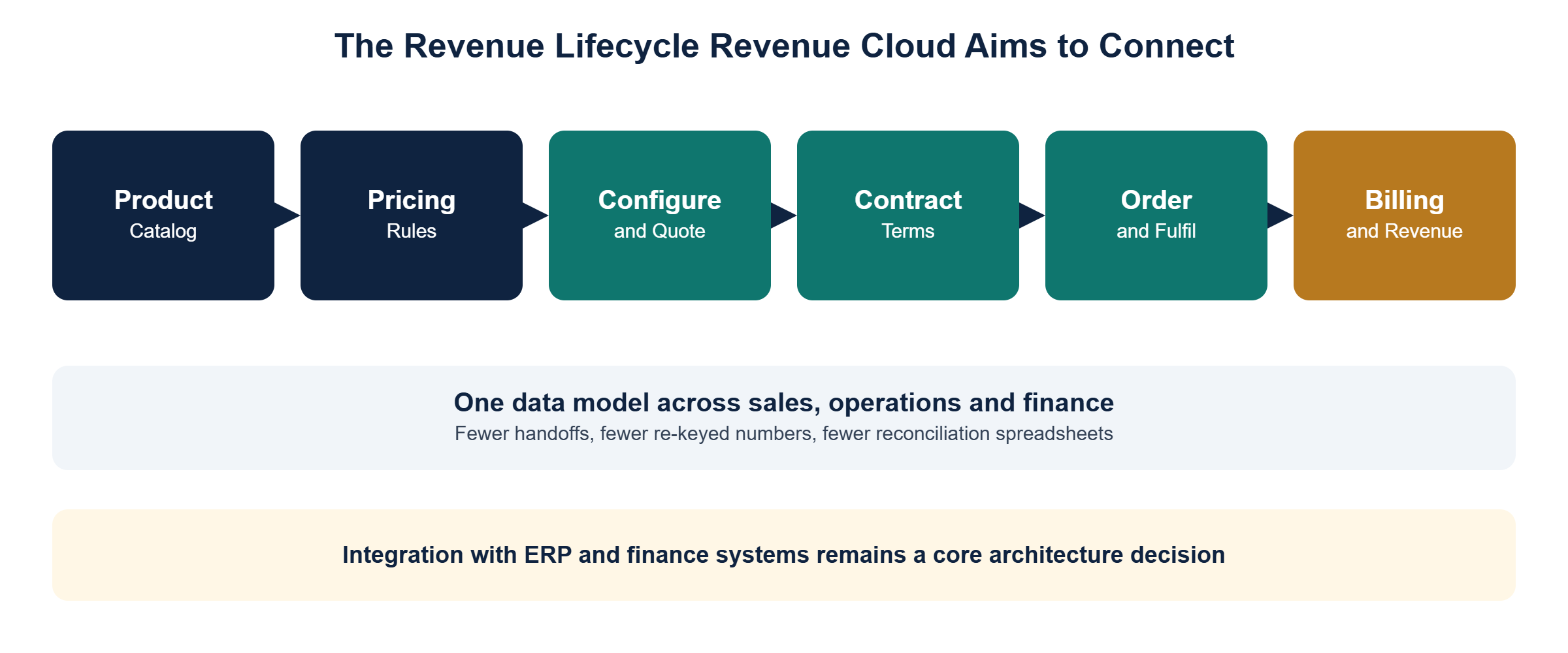
Revenue Cloud covers the revenue lifecycle: product catalog, pricing, configuration, quoting, contracts, orders, billing and related revenue processes.
Its history is a little confusing, so a quick summary helps. Salesforce introduced Revenue Lifecycle Management in 2024, renamed it Revenue Cloud Advanced, and has since been positioning it within its broader Agentforce brand. It is built natively on the core Salesforce platform and is designed as the successor to the older Salesforce CPQ and Billing managed packages.
Why Architects Should Care
Moving from legacy CPQ
Many organizations run Salesforce CPQ today. Revenue Cloud Advanced is a different, platform-native product, not a simple upgrade. Moving to it is a real transformation project, with data, configuration and process redesign. Plan it like one.
The product catalog is the foundation
In every quote-to-cash program I have seen, the product catalog decides whether the project succeeds. Bundles, options, attributes, pricing rules and dependencies need to be designed with care. A messy catalog in a new tool is still a messy catalog.
Pricing complexity
Subscription, usage-based, tiered, multi-year and partner pricing models can all be supported, but each adds complexity. Simplify pricing where the business allows before you automate it.
ERP and finance integration
Revenue Cloud does not automatically replace ERP. Most enterprises still need clear integration with ERP and finance systems for orders, invoices, payments and accounting. Decide early which system owns each step.
Data model alignment
Accounts, products, prices, quotes, contracts, orders and assets must flow consistently between Salesforce and other systems. Getting the identifiers and ownership right saves a great deal of reconciliation pain.
A Practical Approach
- Map the current quote-to-cash process end to end, including every spreadsheet and manual step.
- Simplify products and pricing before configuring anything.
- Decide the system of record for each object and step.
- Design integrations with ERP and billing early.
- Deliver in phases, starting with a product line or region.
- Measure outcomes: quote time, error rates, days to invoice.
Final Thought
Revenue Cloud is not just a quoting tool.
When it works well, it gives sales, operations and finance one shared version of every deal, from the first quote to the last invoice. And that, more than any feature list, is what the business is really buying.